Showing posts with label BSE Listed company. Show all posts

Wednesday, March 22, 2017

Crompton Greaves targets double-digit growth this fiscal


Crompton Greaves targets double-digit growth this fiscal

Updated: March 20, 2017 23:10 IST | Our Bureau

Electrical appliances major Crompton Greaves Consumer Electricals Ltd is hoping to close the fiscal with double-digit topline growth, even as it aims to boost brand recall amongst the younger generation.

Crompton Greaves Consumer Electricals products are now branded as ‘Crompton’.

Till April-December 2016 (the first nine months of this fiscal), the topline growth had been 12 per cent. The company reported a turnover of ₹2,900 crore and a profit after tax of ₹204 crore during this period.

According to Matthew Job, CEO, the company is expecting some impact of demonetisation in the ongoing January- March quarter (Q4 on this fiscal) and a “probable spill-over” in Q1 (April to May) of FY18. “We feel that despite demonetisation, our overall growth this fiscal is likely to be in double digits,” he said here on Monday adding that the company was targeting to grow faster than the market.

Crompton Greaves Consumer Electricals operates primarily in four verticals that include fans – where it has a leadership with 25 per cent market share; lighting; pumps (it has another 25 per cent market share in residential pumps category and a 7-8 per cent in agricultural pumps); and small appliances. Fans contribute close to 40 per cent of its turnover and lighting forms another 30 per cent. Pumps and small appliances account for 20 per cent and 10 per cent, respectively.

Targeting youngsters

According to Job, the new management has decided to invest around 2-3 per cent of the turnover towards brand building and is looking to reach out to the younger generation.

The company, he maintained, had high recall value amongst the older generation compared to the youth. Hence, a conscious decision has been taken on the branding front.

“In the past, the company did not invest in the brand. Now we are targeting nearly 2-3 per cent of our turnover towards marketing spends and in building the brand,” he said adding that Crompton was also in the process of getting a five-year blueprint ready.”

Tuesday, February 14, 2017

Demand may return to normal in 3-6 mnths: Crompton Consumer Elec


Crompton Greaves Consumer Electrical expects it will take at least 3-6 months for demand to be back to normal as demonetisation-led inventory build up and uncertainty in the real estate sector impacted business.

Speaking from the sidelines of Edelweiss India Conference, the company's MD Shantanu Khosla told CNBC-TV18 the company has gained market share from both the organised and unorganised players.

He says Energy Efficiency Services (EESL) provides scale, which enables them to reduce the cost of LED, and that is passed on to consumers.

The company is working on cost reduction of projects to mitigate the rise in commodity prices and looking at premium end of the market which helps it to improve the mix.

The company reported strong earnings for Q3 with revenue increasing 9.7 percent at Rs 888.9 crore versus Rs 810.1 crore in corresponding quarter last fiscal. Profit was up 39.3 percent at Rs 57.4 crore from Rs 41.2 crore in year ago period.

Below is the verbatim transcript of Shantanu Khosla's interview to Sumaira Abidi and Anisha Jain on CNBC-TV18.

Sumaira: You reported a very strong set of numbers just a short while back but we were listening to some of the takeaways from the analyst conference call that you had post your numbers. You said that definitely the impact of demonetisation is not entirely behind us. By when do you expect for this impact to be over for normalcy to return and can this trajectory of earnings then continue?

A: It is very difficult to predict exactly how long it will take to come completely back to normal because there is potentially some amount of inventory down the channel plus longer-term uncertainties such as the impact on real estate, which impacts our business, I would -- if I had to guess -- say probably three-six months would be the timeframe.

Anisha: You mentioned that you are more exposed to the business segment, so can you please bifurcate what is your sales from business to retail and what part comes from business to business?

A: Primarily our business is business to consumer (B2C). It is only in lighting segment where about 40 percent of our business is B2B. What I had mentioned earlier was there is a correlation between our business and the real estate business. So if the real estate business takes some time to recover that does have a correlation with consumer electricals since a lot of our products are bought along with new property.

Anisha: Give us a word on the gross margin, this time around the beat was around 200 bps higher than last year. With the raw material prices going up, do you see that there might be some pressure going forward or the price hike that you have taken in January, you intend to keep on taking the price hikes, so that you can manage the margins?

A: We will work a couple of fronts given the commodity cost pressure, one is pricing but beyond pricing, it is also critical for us to continue to work actively focused cost reduction projects and the final thing is strategic choice on driving more of the premium end of the market, which helps improve our mix. Pricing we will obviously have to ensure that we stay competitive.

Anisha: You did mention in your conference call that in November and December, you had scaled back some advertisement spend, would we see that coming in Q4 and therefore the spike in the advertisement spend in Q4?

A: We are back in Q4 to advertising at normal levels.

Anisha: Coming to the cost reduction programme that we have been having and even the Energy Efficiency Services (EESL) impact as far as LED and fans is concerned, how do you see EESL impacting the fan segment as well as the LED business going forward?

A: On LED like I had mentioned before, over the long-term EESL has a very positive impact because it has helped provide scale to all of us which has enabled us to reduce cost which will be passed on to the consumer. I do believe however in some of the other segments such as fans, pumps, the impact of the EESL programme will be less than has been on lighting and that is because fans, pumps also involved an installation by a service provider, an electrician, a contractor etc which lighting doesn’t.

Anisha: You were waiting for the December numbers to come by and to discuss the part of demonetisation. Now if you would have a clear idea in terms of the market share, what the growth has been from the unorganised sector to the organised sector and how has the market share been in the December quarter?

A: Our market share in this quarter have grown across our core businesses, consumption market share and we are gaining share from both organised and unorganised.


Monday, February 13, 2017

India Home Loan Exec. Dir. interview


Mitesh Mahesh Pujara, Executive Director, India Home Loan Limited
India Infoline News Service | Mumbai | February 13, 2017 16:38 IST

“Gujarat, Maharashtra will remain our focus states while Rajasthan may add to our revenues.”

Mitesh Mahesh Pujara serves as a promoter at India Home Loan Limited and has been its Executive Director since August 19, 2015. Mr. Pujara served as Non-Executive Director at India Home Loan Limited from August 21, 2008 to August 19, 2015. Mr. Pujara has an expertise in the areas of Finance, Capital & Stock Market Operations. He holds Bachelor of Commerce degree and has been instrumental in the company's growth in the home loan segment.

India Home Loan Limited (IHLL) is a Housing Finance Company (HFC) which offers retail home loan product for affordable housing segment. Under this product, loans are offered to the customers for Purchase of home, home improvement, home extension and for construction of a dwelling unit on an owned plot of land. India Home Loan Limited formerly known as (MHFCL) Manoj Housing Finance Company Ltd which was incorporated on 19th Dec 1990 under the Companies Act, 1956 in Maharashtra. In 2009, the name of Manoj Housing Finance Company Ltd has been changed to India Home Loan Limited. India Home Loan Limited is a BSE listed company. The company came out with an IPO (Initial Public Offering) in 1995 to augment its long-term resources to meet the needs of the business of housing finance and enhance its borrowing capacity by improving its net worth. Presently the company operates from branches in Urban, Semi-Urban &Rural areas of Maharashtra and Gujarat with own offices, DSA (Direct Selling Agents) and Business partners.

As all the real estate and housing finance companies got big boost from the Finance Minister in the last Union Budget, how are you planning to exploit this opportunity?

We are already addressing the affordable housing segment and have a strong presence in this market in Gujarat. While in Gujarat our focus remains on major cities like Ahmedabad, Vadodara and Surat, cities under our focus in the state of Maharastra include certain pockets in the outskirts of Mumbai and also places like Dombivali, Kalyan, Bhiwandi and Jalgaon and also expanding further in the adjacent areas where major developments in reference to real estate activities are taking place. Being a leading player in this segment, I must say we will aggressively pursue our targets through our network of DSAs across the country and mainly in the western states and directly with the developers of affordable housing segment. Toeing the line of the central government, our contribution will remain significant in this segment in the next three to five years to begin with.

As we have seen most of the banks have lowered the lending rates, can you throw some light about how much impact would it have to reduce India Home Loan's cost of capital? 

Overall 1 - 2 % has been the impact due to reduction in rate of interest in the broader market. However, I must tell you here that the government initiative (CLSS) in passing on subsidy on the interest will have significant impact on the interest cost reducing it by 4 - 6 % per annum and this is going to encourage the aspiring home-buyers as well as the players in the real estate market. We can also tell you this will strengthen business of companies like us.

Most of the financial institutions are finding their ways to housing finance sector, do you see any threat to your company because of this boom? As per you, what are the major challenges you have in this business and how are you planning to combat them?

Competition from bigger group is a threat but the market is too big and we are still a growing player and we do not see this affecting us significantly. The home loan segment as you are aware has been expanding fast and lots of people in the thirties are going for home buying. So there is adequate space for each of the players in this segment, be it the bigger ones and the smaller ones. Also note that the expansion in the smaller segment is equally fast, rather faster than the bigger segment. We have enough space to play and this will help to strengthen our topline in the next one to two years, for sure.

How will JM Financial as investor help the company in scaling up your existing housing finance business?

Their present infusion in equity capital and the possible future infusions as the company grows will certainly help us in consolidating our position. This is a big and significant development in our company.

Apart from housing finance, do you have any plans to diversify your business in other lending segment of finance? 

We are focused only on home loans, LAP and construction finance to developers of affordable housing projects and for now we wish to stay glued in these core areas where we have our expertise. Expansion or further spread, as you may say, will come at a later stage. Now is the time to make our mark more significant in the home loans segment.

Do you have any plans to expand the companies target regions other than Maharashtra and Gujarat? Do you have any plans to spread wings beyond your existing presence?

In the immediate future, we will continue to focus on these two states, Gujarat and Maharashtra only while we have already started exploring markets in various cities in Rajasthan. So while we strengthen our presence in western India, gradually at a later stage, we may opt for entering into northern Indian states, like Rajasthan.

Do you have any plans to change in you capital structure? At what rate are you expecting your loan book to grow in the Calender year 2017? If you can throw some light on you financials and its outlook?

As capital infusion takes place, our capital structure may undergo some changes but the present promoter group would continue to manage the affairs. We expect to grow from present Rs 32 cr to about Rs 48 cr by March 17, > Rs 200 cr by March 18 and close to Rs 350 cr by March 19.

Your message to shareholders?

The company is on the growth path and growing stronger. We can assure of a strong organic growth during the next two years.

Wednesday, February 8, 2017

Mandhana Retail eyes smaller cities to expand Being Human brand


Wed, Feb 08 2017. 12 41 PM IST

Mandhana Retail eyes smaller cities to expand Being Human brand

Plans are afoot to open 100 exclusive Being Human stores in the next four years across tier-II and tier-III cities like Raipur, Bikaner, Guwahati and Vapi

New Delhi: Textile and apparel manufacturing company Mandhana Retail Ventures Ltd, which sells the Being Human brand of clothing, is planning to expand its footprint across smaller towns and cities for the next phase of growth.

The company is planning to open 100 exclusive Being Human stores in the next four years across tier-II and tier-III cities like Raipur, Bikaner, Guwahati and Vapi.

“The focus is on tier II and tier III because these are the growing cities with good disposable income. The aspirational value of our brand is much higher in these cities,” said Manish Mandhana, managing director at Mandhana Retail Ventures.

Currently, the company operates 60 exclusive stores across 40 cities, including Ahmedabad, Ambala, Amritsar and Bengaluru.
Mandhana Retail has the global licensing arrangement with Being Human (The Salman Khan Foundation) to design, manufacture, retail and distribute textile products. The royalties from the clothing line support education and health care initiatives of the Salman Khan Foundation.

Priced between Rs699 and Rs9,999, Mandhana sells Being Human clothing through exclusive stores, multi-brand outlets like Central and Shoppers Stop and online marketplaces like Myntra, Jabong and Flipkart. All combined, the company has 600 sales points, including international stores (125 in the Middle East and 75 in Europe).

“20% of our revenue comes from exports and online marketplaces contribute 8% to our overall sales. We have been growing at the compounded annual growth rate of 65% over the last three years,” Mandhana added.

In September 2014, Mandhana Industries had announced the demerger of its retail business and trading operations to Mandhana Retail Ventures, which took place in April 2016.

Earlier in September 2016, the Being Human brand also ventured into the jewellery segment and launched an independent line of diamond jewellery in collaboration with Style Quotient Jewellery Pvt. Ltd.

Style Quotient is the exclusive global licensee of Being Human jewellery.

According to a March survey by consulting firm AT Kearney, the Indian fashion and lifestyle market is expected to touch Rs3,94,000 crore over the next five years, growing at a compounded annual growth rate of 12%.

Currently, the market is estimated at Rs2,21,000 crore.

Wednesday, May 11, 2016

Max Ventures to enter hospitality space


Max Ventures to enter hospitality space with Azure stake buy, commits Rs 33.5 crore investment
By Arun Kumar, ET Bureau | 12 May, 2016, 04.33AM IST

EW DELHI: Max Ventures and Industries (MVIL) owned by serial entrepreneur Analjit Singh is venturing into the hospitality space with a binding agreement to buy a minority stake in Delhi-based Azure Hospitality, which runs a pan-Asian restaurant chain under the Mamagoto brand, said two people familiar with the development. "Azure Hospitality is raising $10 million in the second round of funding from MVIL and Goldman Sachs," said the one of the persons. 

"MVIL has committed to invest Rs 33.50 crore or $5 million for acquiring 11.2% stake in Azure Hospitality," the person said. Earlier this January, Singh, 62, the promoter of Max India resigned as chairman of most of his holdings and group companies in a move aimed at inducting professional managers to run his sprawling business empire. 

He remains the chairman of MVIL and owns 40% of it, but has made an open offer to raise his shareholding upto 74%. Singh has been pushing MVIL to become a key player in incubating and promoting new business ventures for the group. Sahil Vachani, managing director of MVIL and also Singh's son-in-law, confirmed that the company has invested $5 million in Azure Hospital for a minority stake. He refused to divulge details of the investment. 

"MVIL is looking at four verticals — packaging, education, real estate and investments (picking up minority stake in)," Vachani said. "We are looking at providing growth capital and synergy to investee companies," he added. Rahul Khanna, co-founder Azure Hospitality did not respond to queries from ET until press time on Wednesday. 

Goldman Sachs that had invested $10 million in April 2015 has also invested additional $5 million in Azure Hospitality," the second source said. After this round of funding, the original promoters will have between 50% and 60% stake in Azure Hospitality while Goldman Sachs will have around 35% stake, the source said. 

The company launched two budget brands — Rollmaal and Speedy Chow — in 2013 to diversify the business. Both are quick service restaurant chains with Speedy Chow focusing on Chinese cuisine and Rollmaal on Indian offerings. 

Currently, the firm operates in five markets — Delhi-NCR, Mumbai, Bengaluru, Hyderabad and Chennai — and has a staff strength of 750. It is also looking to expand to tier I and II towns and also overseas with a launch expected in the UAE shortly. 

Azure Hospitality is likely to report a turnover of Rs 140 crore during the current fiscal and is being valued by the incoming investors at Rs 300 crore, said the first person cited above. "Azure is a zero debt company and is making reasonable operating profit consistently," the person added. 

In the past, Analjit Singh is also believed to have backed Chez Nini, an upscale French bistro in New Delhi's tony Mehar Chand Market. 

Thursday, April 21, 2016

Dewan Housing in talks to buy Andromeda for up to Rs250 crore


Last Modified: Fri, Apr 22 2016. 04 42 AM IST

Dewan Housing in talks to buy Andromeda for up to Rs250 crore

The Andromeda acquisition will help Dewan expand its reach to smaller cities

Mumbai: Dewan Housing Finance Ltd is in talks to acquire Andromeda Sales and Distribution Pvt. Ltd, one of the largest distributors of loans, mortgage, financing and financial instruments in India, said two persons familiar with the development who asked not to be identified.

The Mumbai-based financial services holding company Casa Capital Management Ltd holds about 80% stake in Andromeda. The deal size is pegged at Rs.200 -250 crore, one of the two persons said. Both added that the talks are at an advanced stage.

Altamount Capital Management Pvt. Ltd is advising Casa Capital on the sale.

“On behalf of its clients, Altamount Capital is in discussions with a few strategic Investors on the acquisition of Andromeda,” said Richa Karpe, director, Altamount Capital. She declined to comment on the valuation or the identity of the potential buyers.

A Dewan Housing spokesperson did not respond to mails, calls and text messages seeking comment.

Sunil Pophale, director at Casa Capital Management, did not respond to text messages and calls seeking comment.

V. Swaminathan, chief executive officer at Andromeda Loans, did not respond to queries.

The Andromeda acquisition will help Dewan expand its reach to smaller cities, the first person quoted above said.

Andromeda Group, acquired by the Malaysian venture capital fund Navis Capital in 2007 for Rs.180 crore, was sold to Casa Capital in 2012 after carving out the loan distribution business.

Started as a direct sales associate for Citibank NA in 1991 by V. Swaminathan, Andromeda currently operates across 16 cities and has facilitated the disbursal of loans worth more than Rs.5,000 crore, according to its website.

Andromeda mostly operates through its website andromedaloans.com, and distributes credit cards, mortgages, unsecured business loans and car loans. Andromeda has partnered with 35 banks and financial institutions, the website adds.

In 2015, Andromeda acquired financial products comparison website Apnapaisa.com in a stock and cash deal.

Andromeda competes with other online aggregators such as BankBazaar and LoanAdda.

BankBazaar boasts of more than 9 million visitors per month and offer 11 financial products across 85 financial brands. LoanAdda provides products of 40 banking partners.

Private equity and venture capital investors have shown a lot of interest in the space.

Last year, A&A Dukaan Financial Services Pvt. Ltd, operator of BankBazaar.com, raised Rs.375 crore from investors led by Amazon.com Inc., Fidelity Growth Partners, Mousse Partners Ltd and existing investors Sequoia Capital and Walden International. Another online distributor Policybazaar.com raised Rs.300 crore from PremjiInvest, Steadview Capital and existing investors Tiger Global Management and Ribbit Capital last year.

In January, online insurance policy aggregator easypolicy.com raised Rs.15 crore in a first of funding led by Ronnie Screwvala’s Unilazer Ventures.

“Financial services distribution businesses have seen quite a few transactions in recent times.Technology has changed the way distribution of financial products happens and specific data analytics are used to map investment patterns. In that context, platforms which use technology in the distribution process have significant value,” said Sanjeev Krishan, partner and leader for private equity and transaction services practice at PwC.

According to start-up tracker Tracxn Technologies Pvt. Ltd, out of the total 163 online financial service aggregators, 76 firms were launched in 2015 and 11 were launched this year.

BankBazaar, the pioneer in online lending, has the largest monthly visitors of 9.1 million (1 February to 29 March ), followed by PaisaBazaar (part of PolicyBazaar.com) with 3.3 lakh monthly visitors, Deal4Loans with 2.5 lakh monthly visitors, RupeePower with 1.8 lakh monthly visitors and ApnaPaisa (acquired by Andromeda) with 1.4 million monthly visitors, according to Tracxn.

Dewan reported a 16.4% rise in net profit to Rs.186 crore for the third quarter ended December, 2015 on higher loan disbursements. Its total income increased to Rs.1,885 crore from Rs.1,525 crore. The loan disbursement of the company for the quarter also rose by 31% to Rs 6,428.37 crore. As on 31 December, Dewan had a total loan book of around Rs.59,000 crore. The company posted a revenue of Rs.5981 crore for FY15.

On Thursday, shares of DHFL fell 0.63% to Rs.205.25 each on BSE.

Centrum Group appoints Jaspal Bindra as new chairman


Last Modified: Thu, Apr 21 2016. 10 19 PM IST

Centrum Group appoints Jaspal Bindra as new chairman

Chandir Gidwani divests around 25% of his personal holdings in the group to Jaspal Bindra

Mumbai: Leading independent brokerage and financial services player Centrum Group on Thursday appointed Jaspal Bindra, ex-Asia Pacific CEO Standard Chartered Bank, as its new chairman in place of Chandir Gidwani who will continue to be the main promoter.

Gidwani has divested around 25% of his personal holdings in the group he set up over 20 years ago to Bindra who has spent three decades working at MNCs, sources told PTI, who, however, could not confirm the value of the stake sale.

For 55-year-old Bindra, who was one of the poster boys of the Indian management talents in global financial markets for over three decades, this is a home coming.

He will be the executive chairman at the diversified Centrum Group and with his considerable stake in the company this is also an entrepreneurial journey for him.

The Centrum Group, set up in 1995 by Gidwani and Khushrooh Byramjee, has 125 branches spanning 48 cities and offers integrated financial services to corporate and retail clients with its investment banking (equity & debt), wealth management, institutional broking and forex services, serving over 1 million customers.

The group also has an NBFC for retail lending and has applied to NHB for a licence to foray into housing finance.

“This is the perfect time for Jaspal to come in as our executive chairman. With his rich and extensive global experience, I am sure he will be able to accelerate our growth. His strategy and execution track record will be extremely helpful as we enter the next chapter of growth,” Gidwani said.

Bindra’s last position at Standard Chartered was as the chief executive of the Asia Pacific region. In February 2015, the bank announced that he would be leaving the company in major global revamp.

“With its reputation, commitment to values, profitable growth track record, large client base and a national presence, the Centrum Group is well-poised for higher growth. I look forward to working closely both with the promoters and the proven executive team,” Bindra said.

Out of the successful global career of over 30 years, he has spent 18 years with StanC alone. He joined the Asia-focused British bank in 1998 and became a director in 2010. He has served in leadership roles in Mumbai and several other Southeast Asian centres heading treasury, capital markets, investment and consumer banking. He is among a handful of Indian-born executives who have reached the pinnacles of the global financial industry.

Bindra, who grew up in Calcutta, joined Bank of America after an MBA from XLRI Jamshedpur in 1984. He later joined UBS and moved to Standard Chartered in 1998 as chief executive for India. He is credited for making Standard Chartered India one of the three largest international banks in the country by assets and its third-largest profit and revenue driver.

Friday, June 12, 2015

Apollo Tyres MD Neeraj Kanwar plans to make it a global player


Apollo Tyres MD Neeraj Kanwar plans to make it a global player
By Moinak Mitra, ET Bureau | 12 Jun, 2015, 05.20AM IST

Neeraj Kanwar doesn't have the fondest memories of 1995. After graduating in industrial engineering from Le High University in the US and a rather forgettable stint at American Express Bank in Manhattan, Kanwar, the Vice Chairman and Managing Director of Apollo Tyres, was back in India heading an NBFC which survived 18 months.

Kanwar's next job would define him. He joined the sales team of Apollo Tyres, the company that his father Onkar Singh Kanwar had run for three decades. Unwilling to be identified as the promoter's son, Kanwar dropped his illustrious surname from his visiting card which simply read: "Neeraj Singh."

Back then, the company was heavily geared to tyres for commercial vehicles (trucks and buses). Kanwar operated out of the dusty Peeragarhi area in north-west Delhi, where his exposure to expletive-spewing dealers and truckers in a cut-throat price environment was a revelation — a worm's eye view of the quick and dirty tyre business.

Today, the 42-year old Kanwar works in cooler climes. For the last three years, he operates out of 1, Maddox House on Maddox Street in London's Soho neighbourhood, a stone's throw from Piccadilly Circus. "It's a great place in the middle of the world and you can network and gauge ideas in the tyre trade and automotive business,"he says. Being in London brings Kanwar close to the foreign institutional investors who own 44 per cent of Apollo stock(the promoters own 37 per cent), though he does visit India for a week every month.

Kanwar is flanked by a global management team—Martha Desmond, chief human resources officer; Marco Paracciani, chief marketing officer; Marcus Korsten, chief manufacturing officer; chief quality officer Pedro Matos; and, chief technology officer Seshu Bhagavathula — all of whom have joined the company in the last 24 months. With this brand new team, Kanwar has set an ambitious target of nearly trebling the company's revenues to $6 bn by 2020 and making Apollo a global player.

A shot that misfired

This isn't Kanwar's first stab at making Apollo a big player in the global tyres business. Apollo began its global foray in a small way in 2006 when it established a foothold in South Africa, snapping up the Dunlop brand. The foray ended with Apollo exiting South Africa in 2013. Meanwhile, in 2009, the company acquired the century-old Dutch brand, Vredestein. Apollo also made a bid to acquire Cooper Tire & Rubber Company for $2.5 billion, which would have been India's biggest overseas acquisition. But the deal fell through in the last days of 2013 as resistance mounted from Cooper's Chinese arm that contributed roughly one-fourth of the company's revenues, and local steelworkers' union. "With Cooper, a lot of things went wrong. The learning is probably that with global companies... when acquiring, one needs to be absolutely sure of the internal operations of the target company, which Apollo clearly didn't," says Anil Sharma, principal, IHS Automotive.

The Cooper episode provided its share of insights for Kanwar. For one, he believes you need a global management team to pull off a major global acquisition. "A few years back, the chunk of top management was from India," he says.

Last October, Apollo hired Martha Desmond with the mandate of building a global talent pool. Having worked in India earlier as part of the London-based BG Group, Desmond is familiar with how businesses in the subcontinent work. "Apollo is nimble and dynamic in decision-making because it is a very flat organisation, unlike a lot of others that get bogged down by bureaucracy... in a family company, you get a much more dynamic, entrepreneurial feel," she says.

In February, Kanwar hired Portuguese quality ace Pedro Matos as his Chief Quality Officer from the world's top tyre company, Continental. Matos was struck by Apollo's "customer orientation and adherence to processes". Also, the fact that Apollo spends as much as 2.3 per cent of its revenue on R&D was a good enough reason for a quality professional to switch.

"When Neeraj hired me, he didn't want me to manage quality of plants or products but to bring in excellence... the idea is to create and build a full global process organisation, with a strong focus on knowledge management," he says. Matos is based at the company's Enschede plant in the Netherlands, which has retained its Vredestein culture. "Neeraj is very clear when he has to intervene or let others run the show. He won't intervene so long you're doing a good job," he says.

With his global team in place, Kanwar has a new target: $6 billion by 2020. And to chase the numbers, he is aided by two presidents with separate P&L responsibilities—Satish Sharma, who looks at Asia Pacific, Middle East and North Africa and the recentlyappointed Mathias Heimann for Europe and the Americas. Today, over 45 per cent of Apollo Tyres revenues come from overseas operations, up from 9 per cent in 2005. By 2020, that number might go up to 60 per cent.

Making the backend front-facing

Apollo's global ambitions have also called for a recast of its supply chain from a push-driven to a pull system, what it calls the replenishment model. With its acquisitions in South Africa (Dunlop, 2006) and Netherlands (Vredestein, 2013), Apollo was saddled with sizeable inventory.

Two years ago, Apollo roped in consulting firm EY to look into its inventory pileup and subsequent loss of sale and market share. "They wanted to create a supply chain that was far more agile and responsive to their business needs," says Ashish Nanda, Supply Chain Leader, EY.So, the entire capability of the organisation was transitioned from a push-based system to a pull system, which meant that the company's response to demand was now based on actual sales rather than somebody's judgement of potential forecast.

Today, front offices, warehouses and all the seven plants, including the one in the Netherlands, are on a pull system. "We had designed the model for our passenger car segment tyres but are now extending it to other tyre categories," says Satish Sharma, President of Asia-Pacific, Middle East and North Africa Markets, Apollo Tyres.Apollo officials say the new system has resulted in a 64 per cent reduction in loss of sales, from 11 per cent to 4 per cent, and 12 per cent improvement in service levels, from 73 per cent to 85 per cent. Meanwhile, availability at plant warehouses has improved by more than 50 per cent.

The global foray will also call for significant investments. Apollo plans to invest Rs 5,500 crore in its new facilities in India and Hungary by 2018-19. When Apollo was setting up its Chennai plant in 2008, the blueprint accounted for some 3,000-odd people. Kanwar fell back on his industrial engineering background to impact a huge reduction by deploying ergonomic design in the plant. Today, the total headcount in the Chennai plant stands at 1,600. And though Europe is far more automated than plants in India, his greenfield plant outside Budapest which is slated to roll out its first lot of tyres by 2017, will operate with just 976 people producing as many tyres as the Chennai plant.

A changing vision

Since his Peeragarhi days, Kanwar has steered the company through several changes and served the company in several capacities. In 2000, for instance, Kanwar served as the company's manufacturing head. Four years later, he took out an 18-member team to Shimla to spell out the company's strategic vision.

Back then, the group had revenues of about $350 million and aspired to become a $2 billion company by 2010. Kanwar chalked out a few things that he would unwaveringly pursue to meet his 2010 target—self-reliance as far as technology was concerned; brands were important; globalisation, that would result in de-risking of geographies; and diversification of product from a largely trucking base to other categories. As a result, Apollo was well past the $2 billion mark in the targeted year.

For the time being, Kanwar's strategy is clear: go global with a global team. Only after a certain traction will he look at setting up operations in those geographies (in tyre business, near-sourcing is the only option to go to market as high freight costs make the business unviable). At the moment, Kanwar's eyes are transfixed on Brazil and South East Asia


Tuesday, June 9, 2015

Outgoing P&G India Chief Shantanu Khosla Set to Join Crompton


Jun 08 2015 : The Economic Times (Mumbai)

Outgoing P&G India Chief Shantanu Khosla Set to Join Crompton

Chaitali Chakravarty, Sagar Malviya & Arijit Barman
New Delhi | Mumbai:

Procter & Gamble India managing director Shantanu Khosla will join the consumer business of Crompton Greaves to spearhead the company under its new private equity owners. Khosla is coming on board in a senior leadership position and is likely to be the vice chairman and managing director, said multiple sources with knowledge of the matter.

Crompton Greaves' consumer division, Crompton Greaves Consumer Products, is being spun out and getting demerged from its parent into a separately listed company through a court approved process.

The 55-year-old, who will switch shampoo and detergents for fans and lighting, will have a board seat and a CEO under him to drive daily operations, said these sources who didn't wish to be identified.

Khosla made his name at P&G where he led several business units around the globe for more than three decades. During the 13 years when he was at the helm of the Indian unit, the company's revenue multiplied more than six times to Rs. 9,000 crore. Last week, P&G India announced Khosla is exiting the consumer products major with effect June 30.

“The trend of hiring professional management by financial sponsors is commonplace globally. It can add a fresh impetus for future growth of any consumer brand,“ said Ritesh Chandra, executive director, head-consumer group, at Avendus Capital.

Around a month ago, Crompton Greaves agreed to sell its consumer electricals unit for `. 2,000 crore to Advent International Corp and Singapore's Temasek Holdings to unlock value and help repair its leveraged balance sheet. After the separation, which received board approval in February, the shareholding pattern of the new consumer company will mirror that of Crompton Greaves.

The consumer electricals unit will be first demerged into a standalone company and will be listed separately. Advent and Temasek bought out the promoter stake of 34.38% in the business -a move that will also trigger an open offer for an additional 25% in the new company . Upon completion, the new PE owners could end up with close to 60% ownership. Both P&G and Advent declined to comment on Khosla's appointment.

“Khosla showed his marketing acumen when he took Hindustan Unilever head-on and gained share in many key categories. The products may be different but he will surely spearhead CG's brand-building initiatives in a space that is increasingly getting cluttered,“ said the CEO of a personal-care company who didn't wish to be named.

Crompton's consumer electrical unit, which accounts for nearly half its standalone business, generated a revenue of Rs. 3,232.6 crore for the fiscal year ended March 31, 2015. On a consolidated basis, the segment contributes a fifth to its group sales but half its operating profit.

The consumer business largely operates in four segments -fans, lighting, water products (pumps, etc.) and kitchen appliances. The first two clearly dominate its sales, together contributing 74%. In fans and domestic pumps segments, it is the market leader. In lighting, the company is third (14% share) while it is No. 4 in water heaters with a 10% share of the market.Scaling up in home and kitchen appliances have been very slow, feel analysts tracking the company .

“The entry of Advent and Temasek will lead to a focused business approach for the consumer business and allow the business to pursue aggressive growth opportunities,“ said a recent Motilal Oswal report.

Tuesday, May 19, 2015

KDDL, PC Jewellers among listed companies making it big online


By Jwalit Vyas, ET Bureau | 19 May, 2015, 04.01AM IST

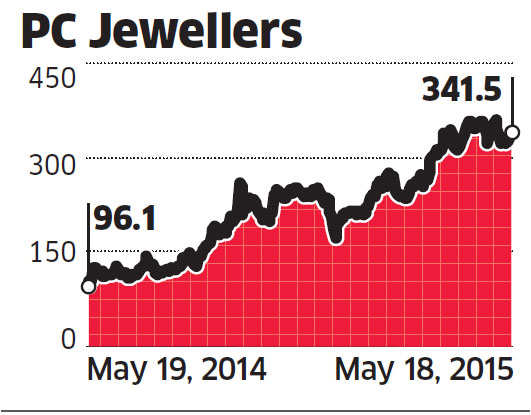
Several retailers have been trying their luck with the online space given the kind of growth opportunities and the valuations that e-commerce companies are enjoying at present. Unfortunately, for the investors, there are hardly any listed companies with significant online presence. However, some of the smart retailers in the listed space such as luxury watch retailer and manufacturer KDDL, and a leading jewellery company, PC Jewellers have managed to get it right. 

These two companies have launched their own websites and have been seeing huge traffic and decent conversion rates. 

KDDL 

Ethos, the watch retail arm of KDDL, derived 23% of its total sales from the online space in FY15 as compared to 16% in FY14 and less than 10% in FY13. Online sales are expected to exceed 30% of the total sales in this fiscal. "It is our best kept secret. Because of this, we don't have to increase the number of stores. A presence in e-retail is helping us grow faster without an increase in overheads such as rents, employee expense and costs associated with inventory storage. 


The saved amount helps us to spend on our marketing activities," says Yashovardhan Saboo, CEO, KDDL. "We have developed such useful customer database which is helping us to identify other lucrative product categories. Once we reach a particular size, we would use this platform for introducing other luxury products." 

The website ethoswatches.com had 6.2 million visitors last year, resulting in 26,400 leads and 5% conversion. Average selling price per item for KDDL is Rs 97,000 as against less than Rs 5,000 for other e-retailers such as Flipkart and Amazon. Analysts expect the online visitors to almost double in FY16 and online sales to more than double in the next two fiscal years. It grew by 90% in FY15. 

Although the company's stock has given a return of over 300% in the last one year, its stock still seems fairly valued. The stock is trading at FY15 P/E multiple of 15 and less than one time sales, which is attractive if one has to compare it with the valuations of other ecommerce companies. 


PC JEWELLERS 


PC Jewellers, which has positioned itself as a wedding jeweller and primarily in diamonds, has entered into the work jewellery segment through its online venture last year. The company at present gets close to 15,000 visitors per day and around 35-40 orders of Rs 15,000 each a day. "This is to acquire future customers. Going by our previous experience, if the customer is happy, she will at least visit our showroom and the conversion ratio in our business is very high, around 70%-80%," said Nitin Jain, head of online business, PC Jewellers.

"Also, by being present online, we are able to tap young customers early on," he added. Its online business is growing over 40% month-on-month, a part of which can also be attributed to the lower base effect. 

Although, at present the online business is less than 5% of total sales for PC Jewellers, one cannot rule out the potential of this business. 

PC Jewellers has been the fastest growing jewellery company in the listed space over the last four years, while most others including Titan Industries have struggled.

Monday, April 27, 2015

Brand visibility top task for CG consumer arm's owners

Brand visibility top task for CG consumer arm's owners

Crompton spent just 3% of revenue on ads and promotions compared to Havells' 9% and TTK's 12%

Aneesh Phadnis  |  Mumbai   April 26, 2015 Last Updated at 22:30 IST

dvent International and Temasek, which teamed up to purchase Crompton Greaves' (CG) consumer products arm from Avantha Holdings on Friday, have their task cut out - ramp up products and promotions and increase consumer connect.

The consumer business unit, which manufactures fans, lighting appliances, pumps and kitchen appliances, is profitable and contributed half the company's standalone pre-tax profit in FY14. The company is number one in the fans and domestic water pumps segments and number three in lighting appliances. But in other areas, growth has been limited.

Challenges are aplenty. Competition is stiff as the consumer electrical goods sector is crowded with established companies and new entrants such as Eveready (in LED lights) and Luminous (fans). While Havells is aggressively pushing its identity as a consumer electrical goods company with multiple brands, players like Bajaj Electricals are premiumising with separate brands such as Morphy Richards. With the companies getting ready to fight for market share, it will certainly be a battle to watch out for.

Also, while CG's strength lies in engineering and manufacturing, it lags peers in advertising and brand building. "CG has managed its working capital cycle and distribution well and ensured that the product quality remains good. But in areas such as consumer connect and brand building, there has been inadequate focus in the past. I expect the new investors to make significant investments in distribution, rural penetration, brand building and product portfolio enhancement," said R Ramakrishnan, group CEO of Polycab Wires.

The new investors may find it easier to drive growth as the consumer business performance will not have an overhang of the slowdown in the domestic power business or the sluggish overseas business - the two factors that impacted CG's overall business performance.


"Crompton Greaves has in the past not focused much on driving growth for its consumer segments owing to issues at its international transmission and distribution business on which most of the focus has been directed. New product launches have been limited, the company has not tried moving up the value chain in terms of premium offerings and has spent inadequately on advertising relative to peers," said Barclays Equity Research in a note to investors last month.

Comparing advertising spends of various companies in this sector, Barclays observed that while CG spent 3 per cent of its revenue on advertising and promotions, Havells and TTK spent 9 and 12 per cent of the revenue for the same purpose. Other companies like Voltas, Bajaj, Philips and Blue Star spent 3-7 per cent of revenue on promotions.

Over the last couple of years, CG has taken a number of steps to expand reach. It expanded its distribution network to 134,000 outlets in the last financial year and started its own exclusive shops. Of this, 22,000 retailers cater to rural India. "CG's strength has been the distribution network it has built over the years but it is not a vibrant brand because of low advertising spends," said Rajeev Karwal, founder-director, Milagrow, a consultancy firm.

"Given that the category is low-involvement unlike big-ticket durables, it all comes down to the brand perception and styling of the products. Hence, all brands in the category are ramping up their ad spends. They also get to leverage their distribution networks (as Havells, Bajaj Electricals and Orient have done)," Karwal, who has had stints at LG Electronics, Philips, Electrolux and headed Reliance Retail's consumer durables arm, had told Business Standard after the company announced the demerger of its consumer business.

An industry expert said CG had a dominant position in fans and the domestic water pumps business but was facing competition from Havells which dominates in high-end fans. "The new investors have an opportunity to grow the lighting and kitchen appliance businesses," said an industry expert.

Shweta Jalan, managing director at Advent International, said "Crompton's consumer business is an attractive business that we believe will thrive as a standalone company as it had leading positions in several fast-growing product categories with strong brand names and extensive distribution capabilities. "Post completion, we look forward to driving growth by investing in sales and marketing, distribution and enhanced product offerings."

Wednesday, January 21, 2015

Textile major Arvind to step into footwear business

Disc : No Holding


Textile major Arvind to step into footwear business

Kalpesh Damor & Piyush Mishra, TNN | Jan 22, 2015, 05.19AM IST

AHMEDABAD: Textile major Arvind is looking to go beyond its core businesses. Riding high on e-commerce wave, textiles and apparels company Arvind Ltd is readying to foray into the Rs 30,000 crore Indian footwear market in a big way. The company will launch its own footwear brand in coming days. 

"Footwear will be a mix of own brands, acquired, licensed and joint ventures. Initially we will have footwear items from our brands such as Arrow, Tommy Hilfiger and Calvin Klein among others," said Sanjay Lalbhai, chairman and managing director, Arvind Ltd, which aims to bring in national and international brands under its portfolio and retail them mostly through the online platform. The Arvind group has already forayed into the realty market. 

As per latest estimates of Council for Leather Exports, India is the second largest global producer of footwear after China, accounting for 13% of global footwear production of 16 billion pairs. Interestingly, 95% of its production goes into meeting domestic demand. 

The company has roped in Rajiv Mehta from Puma India to spearhead its footwear vertical. Mehta, who joined Arvind three months back, was heading German footwear firm Puma's India business for nine years. 

"Rajiv is looking at our footwear vertical and a few other things which we cannot disclose at this moment," added Kulin Lalbhai, executive director, Arvind.

Wednesday, January 14, 2015

Why Sanjeev Bikchandani, the Naukri man, wants to be a builder and funder with Info Edge

Disc : No holding


Why Sanjeev Bikchandani, the Naukri man, wants to be a builder and funder with Info Edge
By N Shivapriya, ET Bureau | 15 Jan, 2015, 02.45AM IST

Every month some 30 million people seeking to satisfy their gastronomic cravings by visiting Zomato, the popular restaurant discovery service, co-founded by Deepinder Goyal and Pankaj Chaddah. In London, people want to know more about the ambience, in Kolkata they want to know more about the food. The nuances are many and Zomato caters to all quirks and palates.

Zomato itself has a distinct global flavour. This week, it took its biggest bite with a $ 52 million acquisition of Seattleheadquartered Urbanspoon, entering the US, the largest and most competitive market. The acquisition also gives Zomato leadership in two other markets, Australia and Canada.

Back home, news of Zomato's acquisition, its global ambition and its huge appetite — six acquisitions in five months — pushed share prices of Info Edge (India) up on a day the BSE Sensex was down. But why the boost for Info Edge? The internet company, founded by 51-year-old Sanjeev Bikchandani, is Zomato's single largest shareholder with a 50.1% holding. Why Sanjeev Bikchandani, the Naukri man, wants to be a builder and funder with Info Edge Bikchandani spotted Zomato early and made a $1 million investment in it five years ago, and followed it up with five more rounds of investment worth a total of Rs 327 crore. Its investments in Zomato are now worth over Rs 2,030 crore.

This is one of the two things Bikchandani is known for. Finding and funding early stage startups and mentoring them to success. Info Edge has invested about Rs 570 crore in backing nine companies like Zomato. Sure, a few deals have gone bad — it wrote off about Rs 35 crore in three of its investments, StudyPlace, 99labels and Floost. But there are more big successes like Zomato.

Info Edge was again an early investor in PolicyBazaar, a portal that helps users compare and choose from different insurance products. At a fund raising last May, PolicyBazaar was valued at $100 million and Info Edge now owns 23% in it.

But the first thing Bikchandani is known for, of course, is his ability to successfully build internet businesses within Info Edge. He is often referred to as the 'Naukri man'; Naukri being one of India's top job portals. 99acres and jeevansathi.com are two more such examples (see table).

Bikchandani is both a builder and a funder. The remarkable thing though is that he has persuaded public shareholders to back him. Info Edge went public in 2006 and non-promoter shareholders own over 55% in the company.

Investors demand that listed companies deliver predictability of revenues and performance. How did Bikchandani get public shareholders to back his plan to build a portfolio of early stage and high risk startups? "Naukri is stable and predictable. The others less so. So it is a blended model with some volatility because of the other businesses.

But by and large, investors are well-informed and well-researched and they factor this in their decisions," says Bikchandani. He expects the top three growth engines for Infoedge in the next few years to be Naukri, 99acres and Zomato.

Bikchandani says that as the company is growing and is of a certain scale, profitable, with a strong brand and a market leader, he sees no reason why investors will not understand the model. Naukri, which contributes more than half of Info Edge's revenues, has a stable and predictable revenue stream. It also contributes more than 100% of the profit — surpluses from this business unit goes into other ventures. By building Naukri successfully, he has earned the right to fund other businesses outside Info Edge.

In the last 12 months, Info Edge's share price has gone up from around Rs 500 to around Rs 850, and its market capitalisation is now close to $ 1.7 billion (Rs 10,385 crore).

Moving in quickly

Zomato has been the most high profile of Bikchandani's bets. It has been growing rapidly. Prior to its US acquisition, last month it acquired Cibando, a restaurant search service in Italy. At last count it was in over 100 cities in 20 countries and investors funding the company valued it at $660 million in December. Only two years ago, it was valued at about $160 million.

Five years ago, Goyal and Chaddah were looking for seed funding and were in discussions with a prospective investor. The discussions dragged on for nearly two months before they got to a term sheet.

Both of them were used to working at a faster pace. Then Goyal got an e-mail from someone he had never met before. That person was Bikchandani and his mail said, "Do you need funding? If yes, you can contact me," also mentioning a mobile number.

"It was basically like cold calling," recalls Bikchandani, who was only acquainted with Goyal through his site, Foodiebay. com, as Zomato was then called.

Within three hours of sending the mail, the two had met and within 48 hours, agreed on the broad contours of a deal. "We went with Info Edge over the others because they were very quick. Speed of execution really mattered to us," says Goyal.

Bikchandani's due diligence consisted of doing basic checks and calling up some customers of Zomato. It was quick, and within few weeks, Info Edge had invested $1 million in Zomato.

"I think entrepreneurs understand entrepreneurs slightly better. Chances are they will be more comfortable with a good entrepreneur than a pure financial investor," says Bikchandani, about why Zomato's founders opted to go with Info Edge. Why Sanjeev Bikchandani, the Naukri man, wants to be a builder and funder with Info Edge
Taking the road less travelled

Bikchandani has challenged many stereotypes without intending to. Despite being an internet venture, his firm, Info Edge, has been profitable since 2003. In 2006, it listed on stock exchanges in India when others like Rediff and Sify were listing on the Nasdaq. Even today it is one of the handful of internet firms to be listed here along with those like Just Dial.

Info Edge is one of the few internet portals and ventures, even globally, that have managed to survive and stay successful from the last internet boom to the current one. "Bikchandani's strongest quality as an entrepreneur is in developing a very robust business model," says Renuka Ramnath, who was MD and CEO of ICICI Ventures, when Info Edge was one of its portfolio companies.

Bikchandani saw Naukri through the dotcom boom and the bust in the late 1990s and 2000 and made a big shift from an onlineonly business model to one which also had a physical presence.

"He felt it was important at that time," says Ramnath. "To have the confidence to change the business model, make a significant course correction, get the buy-in of investors and take the company forward is where most entrepreneurs falter. He did that extremely well," she adds. Ramnath now runs her own fund, Multiples.

When the dotcom bust happened, ICICI Ventures withdrew from many companies but stayed invested in Info Edge. "We had full confidence in Sanjeev (Bikchandani) and Naukri so we stayed invested," says Ramnath. The decision turned out to be right, giving ICICI Ventures a more than 28x return on its investment.

Bikchandani doesn't make any personal investments, though many entrepreneurs of the last dotcom boom vintage have become angels or started venture capital funds. All investments are made through Info Edge. Bikchandani says this is to prevent any potential conflict of interest. "Info Edge is diversifying. If we invest in our personal capacity, we may end up competing," he says.

Onl ine travel booking venture, Makemytrip.com, recently announced a $15 million fund for investing in innovative startups but only for those in allied areas like travel technology. Info Edge, on the other hand, doesn't have a specific corpus from which it invests and target companies need not be related to its core business. The only criterion is they have to be consumer internet firms.

Riding the next internet wave

Similar examples of other ventures that do this are global ones like Naspers, Softbank and Rocket Internet. So is Info Edge modelled on them? Pat comes the reply: "We want to be like ourselves only. We will continue to do what is best for us and our shareholders and our company."

Why did he chose this model? "We (Info Edge) have surplus cash. There are plenty of opportunities out there which smart entrepreneurs are chasing. We can't do everything in-house so we back entrepreneurs who are chasing good ideas and hopefully end up creating value for our shareholders," he says. For Indian investors, investing in Info Edge is one way to participate in the country's booming consumer internet story.

It's also how Info Edge has become a major player in the next internet wave. In September, Info Edge raised a QIP of Rs 750 crore — a large part of the proceeds will go towards building more capability for 99acres. Since then it has acquired 3D design studio and integrated it with 99acres.

Goyal says Bikchandani looks for a return from his investee companies like any other investor but recognises entrepreneurs are best positioned to run their companies. "He's not actively involved in the business but he is always there in the background if you need him. More like an older brother who will always be there to support you through the good and the bad," says Goyal.

When Zomato launched in the UK last year, Bikchandani felt it was too early to enter that market. Over the next three to six months as the struggled in the UK, Goyal realised Bikchandani was probably right. "Still, we never heard, 'I told you so', from him. We were actively thinking of how to solve it and how to make it work," says Goyal.

Bikchandani says being an entrepreneur himself, he understands entrepreneurs need independence. "While we offer our advice, if they don't want to take it, we don't impose it." And that's from a man who has built and funded so many successful businesses.