Showing posts with label Footwear. Show all posts

Sunday, June 14, 2015

Smart marketing & prudent attitude took Puma to the top of the sports shoe heap


Smart marketing & prudent attitude took Puma to the top of the sports shoe heap
By Rajiv Singh, ET Bureau | 10 Jun, 2015, 05.16AM IST

In 2012, time was running out for Puma India. The German sportswear maker entered the country in 2006 but struggled to catch up with its famed global rivals. Nike had a four year lead, Reebok had launched 13 years before and its German sibling Adidas had already been in the market for 11 years. The sibling rivalry between Adidas and Puma is incidentally both very real and the stuff of legend. The brands were started by brothers turned competitors Adi Dassler and Rudi Dassler. In revenues, Puma trailed Adidas by a staggering Rs 300 crore and Reebok by a little under Rs 100 crore.
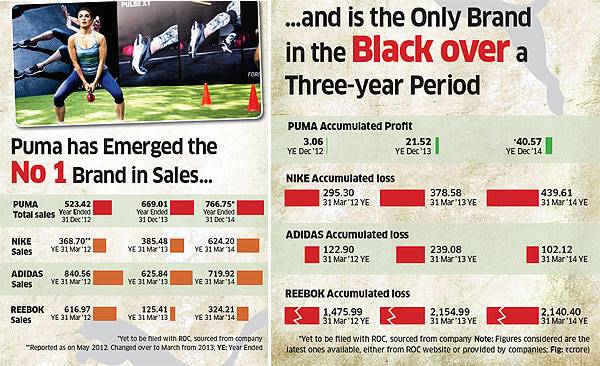


It had two options: either fall back on discounting to push sales or continue with its strategy of slow and sustained growth. It chose the latter. And it seems to be paying off if you look at the latest numbers, which indicate that not only is Puma ahead on a topline basis, it is also the only one amongst the three that isn't saddled with piled-up losses (see chart; a caveat here; Puma's numbers are for the year ended December 2014, whilst those for Nike and Adidas are for the year ended March 2014; whilst these may not be strictly comparable, they are the latest available numbers).

"When Puma started in India in 2006, I used to fret about how difficult it would be to compete with established players. But in eight years we are No 1," says Abhishek Ganguly, managing director, Puma India. The brand focused on offering desirable products that deliver on the price-value proposition, adds Ganguly, who has been with Puma since 2006 and was recently elevated to head the country's operations. Former managing director Rajiv Mehta in an earlier interview with Brand Equity had said the brand initially positioned itself more on the lifestyle plank than pure performance, the domain of its rivals. On his watch, the brand began Puma Loves Vinyl, a concert and music compilation series showcasing Indian indie acts and the Puma Social Club in Bengaluru, which features a cafe and a bar.

Puma's success in India, say marketing experts, lies in smart rather than aggressive marketing, prudent expansion and sticking to the basics of shunning discounts. "Most of the sportswear brands have been using price-discounting as a tactic for increasing sales. This affects the margins and hits profitability," says Ashita Aggarwal Sharma, professor of marketing at SP Jain Institute of Management & Research. The Indian units of Nike and Adidas declined to comment on the story.

What also helped Puma in becoming profitable was a sensible expansion strategy. That it is still not the most widely distributed brand in the country may perhaps be a reason it doesn't find itself in a sea of red; it has 430 stores across India whereas for the Adidas-Reebok combo the number is over 750; Nike says it sells through 3,000 touch points, including exclusive outlets and multibrand outlets. "We didn't over-expand and over-distribute in markets. This helped our profitability as we didn't open stores just for the sake of doing so," says Ganguly. He adds that till date Puma has had to shut down just six stores. (Adidas, Reebok and Nike declined to share numbers of stores added or closed over the last three years.)

Puma insists it did not benefit from the alleged financial irregularities that rival Reebok was hit by in 2012, and which led to shutting down of hundreds of its outlets. "Strong and sustainable brands and businesses do not get built on others' losses," says Ganguly. Puma has built its foundation in India on the back of a desirable product mix and engaging marketing, he adds. "We ensure that we reach out to our consumers with talk-worthy experiences like getting runner Usain Bolt down to India last year," says Ganguly, who declined to share Puma's marketing expense but added that digital accounts for up about 70 per cent of their marketing spend in India.

Puma's apparent handicap of being the last one to enter the Indian market turned out to be its biggest strength, brand experts point out. "Puma came last, so it learnt from the mistakes of everyone," says brand strategist Harish Bijoor. It entered a category that was already created and a market that was already explored to death. "Pioneers in categories tend to spend a lot, and often bleed a lot."

Still, Puma is ahead of Adidas and Nike in sales by the narrowest of margins, and the 1-2-3 positions could well change soon. Ganguly plays it cool. "We take each year like a session of Test cricket." A marathon may be another metaphor Ganguly may have in mind although Bolt, a Puma ambassador who's widely regarded as the fastest man ever, may think a bit differently.


Monday, June 1, 2015

Puma clocking sales as much as leader Adidas despite its late entry into the country


By Shambhavi Anand & Richa Maheshwari, ET Bureau | 2 Jun, 2015, 04.30AM IST


NEW DELHI: Puma, which made its India debut in 2006, said it posted sales of Rs 766.75 crore in the 2014 calendar year, inching closer to companies such as Adidas and Nike that entered the country earlier. 

The company has built on the advantage it took of a gap in the market when Reebok India took time out to deal with an alleged fraud in 2012 "I would not deny that the competition's weakness was an opportunity that we grabbed," said Abhishek Ganguly, managing director of the German company's local unit, in an interview. Among the measures it took was stepping up engagement with Reebok's biggest vendor, Rishabh Sports Station. Around 300 of Reebok's 900 stores were shut by parent Adidas as it sought to take stock and relaunch the brand. 

This allowed Puma to fill the gap in the market created by Reebok's absence. It also won the trust of Reebok's vendors by utilising their capacity. 

"Puma reacted to the vacuum that was created suddenly by Reebok's misfortune. They were able to win over some of the vendors whose capacities were lying unutilised," said an executive at one of the suppliers that works with both Puma and Reebok. Reebok franchisees that app roached Puma for a possible tieup were carefully evaluated. Puma was conservative with its storeopening strategy.

"We did not convert... stores (where) we already had a store in that market or they were at undesirable locations," said Ganguly. 

"In terms of franchisee management, we focussed on long-term sustenance of our stores and never opened multiple stores in the same location. We have always believed in quality distribution and not in over distribution. In some ways, we had the late-mover's advantage and we learnt what not to do. So while others focussed on just opening stores, we put our energies in improving our customers' experience in our stores." 

Puma also zeroed in on style to get the product mix right, launching Alexander McQueen's global collection in India. 

"They've focussed on product design, and the brand is clearly at a premium position through its pricing. They've been able to connect well with the younger consumer on the desirability plank," said retail analyst Devangshu Dutta of Third Eyesight. 

The Bangalore-based company also created open sandals and flipflops exclusively for the Indian market. "We sell over 5 million pairs of these every year," said Ganguly. 

Among the competition, Nike India posted a loss of Rs 47 crore for the year ended March 2014, according to a filing with the Registrar of Companies (RoC). The company entered India two decades ago. Despite its troubles, Reebok posted a net profit of Rs 14.5 crore, while Adidas made a profit of Rs 136.9 crore. 

According to internal numbers, Puma made a profit of Rs 29.09 crore in calendar 2014. 

"We have grown over 13% in 2014 as compared to 2013 in terms of same-store sales," Ganguly said. Puma has 340 stores, of which 40 are run by the company. Product prices range from Rs 1,599 to Rs 15,000. 

The entry level price has come down substantially in the last few years and so have discounts. Puma will boost its online presence in the coming months. It will also act as a market place for its franchisees. They are currently barred from selling on marketplaces such as Flipkart, Amazon and Snapdeal in a bid to curb any heavy online discounts. The company currently conducts business on those marketplaces directly

Wednesday, March 25, 2015

Puma to make India a manufacturing hub


http://www.thehindubusinessline.com/companies/puma-plans-to-buy-out-partners-stake/article7032581.ece

Puma plans to buy out partner’s stake

PURVITA CHATTERJEE

To launch own stores, make India a manufacturing hub

MUMBAI, MARCH 25: 

Puma Sports India, which recently got the government’s approval for bringing in FDI, is planning to buy out its partner Knowledge Fire’s 49 per cent stake in joint venture Puma India Retail, and to launch own stores in the country.

Also on the cards is making India a manufacturing hub for the company’s products, said Abhishek Ganguly, Managing Director, Puma Sports India.

FDI proposal

Puma had proposed to bring in Rs 10.1-crore ($1.66-million) FDI, which the Foreign Investment Promotion Board approved late last year.

Currently, Puma has two companies in India — Puma Sports India (the holding company) and Puma India Retail, a 51:49 joint venture with Knowledge Fire. It is operating in the country through the single brand retail route.

“We have got FDI approval and will push for more footwear manufacturing in India, from the current 40 per cent to 60 per cent Made in India products,” said Ganguly.

“Our joint venture will also get dissolved as we are considering buying out the local partner’s 49 per cent stake and there will be greater involvement in retail. India is going to be a market of focus for Puma.”

Franchisee stores

Puma currently has 340 stores, of which about 230 are owned by smaller franchises and the rest by Knowledge Fire.

“We will continue having franchise-led stores for smaller markets, while our company-owned stores will be for the larger and more expensive real estate markets as we do not want to disturb the balance with our franchises,” added Ganguly.

Besides, India is also expected to emerge as a manufacturing hub for the sportswear company as it expects to shift its dependence on China for sourcing footwear.

“Almost 80 per cent of global sportswear manufacturing happens in China and we are now looking at an alternative destination. India could become a hub for the global market as manufacturing in China should get balanced,” he added.

Investment plans

However, with FDI being approved, Puma is planning to increase its number of stores and also enhance sub-contracted manufacturing, creating more employment opportunities. The company plans to invest about Rs 1.5 crore for each new store it plans to open measuring about 2,000 sq ft.

Focusing on areas like running and woman’s fitness, Puma has recently roped in Lisa Haydon to endorse its new footwear brand – Ignite.

Puma was one of the last entrants to enter India in 2005 after Reebok, Adidas and Nike in the sports footwear segment. However, both Nike and Reebok have yet to get FDI approval to sell through their own stores and are currently engaging in the wholesale cash & carry route to do business in India.


(This article was published on March 25, 2015)

Friday, December 26, 2014

Puma plans to leap across value chain


The sportswear brand, second in sales, is bringing in brands from its global portfolio to tap the premium consumer, different from its positioning so far
Reghu Balakrishnan  |  Mumbai   December 23, 2014 Last Updated at 20:50 IST

Puma, the global sportswear brand, known for its lifestyle and sports apparel and shoes, is looking to strengthen its position in India. It is up against brands such as Adidas and its sister brand Reebok, and Nike. Under new leadership, Puma is now gearing up to grab a larger market share by bringing some of its global brands for hardcore sports enthusiasts.

Under the leadership of its new managing director, Abhishek Ganguly, Puma is eyeing pole position. According to the Registrar of Companies data for 2012-13 (the latest year for which RoC data is available), Adidas registered sales revenue of Rs 625 crore while Puma registered Rs 497 crore sales, ahead of Nike (Rs 385 crore) and Reebok (Rs 125 cr). In 2011-12, Puma had registered sales of Rs 352 crore. In FY-12 and FY-13, it was the only brand to register accumulated profits. The current market of sportswear is estimated to be Rs 5,000 crore.


Reading the consumer trend of trading up, Puma is bringing its premium global brands to India. Ganguly says, "We are in process of creating a strong brand awareness through various marketing and product-launch initiatives. We are bullish on India and we have seen a major shift to high-end products by Indian consumers. Hence, we want to bring our global sports assets shortly."

Puma has already launched two of its popular global brands - Mobium and Faas in India. The Mobium Ride NightCat, priced at around Rs 9,000, is built for the more traditional heel-striker looking for an everyday pair of running shoes. The Mobium Band is built for those who hit the pavement heel first, ensuring safety. The 360-degree reflectivity and blue LED light, features of the NightCat sub-brand, ensures safety in low-light conditions. Its other brand, Faas 600 S, is in Rs 8,000-range.

Ganguly says the ranges are justified because consumers are ready for high-end technical shoes that cost around Rs 10,000-15,000 for daily jogging. "A few years ago, we saw the trend of consumers buying any kind of sportshoes for jogging by middle-class families. Nowadays, they are more brand-conscious, unable to compromise on quality and ready to pay premium for sportshoes," says Ganguly. Puma is bringing another range of brands which would be technically fit for elite runners and costlier than the Mobium and the Faas series.

It would be a challenge for Puma to make the jump to the higher-end of the spectrum. So far it had been pricing its sportshoes lower than players such as Adidas and Nike. In the Indian market, Adidas has carved itself a position of being a sportswear brand for professionals and pro-use, Nike has retained its youth and innovation pegs while Reebok, after the debacle of mismanagement a few years ago, is trying to reinvent its image as sportswear for lifestyle sports and games.

Puma will back its bid for the premium consumer, by adding more stores. "We don't believe in setting up more stores just for the sake of expansion. We are looking at select pockets. We have identified new malls coming up at Mumbai, Delhi and Hyderabad to start our new stores," says Ganguly.

Puma created a stir with its branding earlier this year when it for its ambassador and the fastest man in the world, Usain Bolt, to India for the first time. Hes formally launched Puma's new global brand positioning, 'Forever Faster', in India in September, 2014. The tagline underlines how Puma wants to be seen as a sprightly sportswear brand.

Puma will have to be careful not to lose its share once it leaps across the value chain.